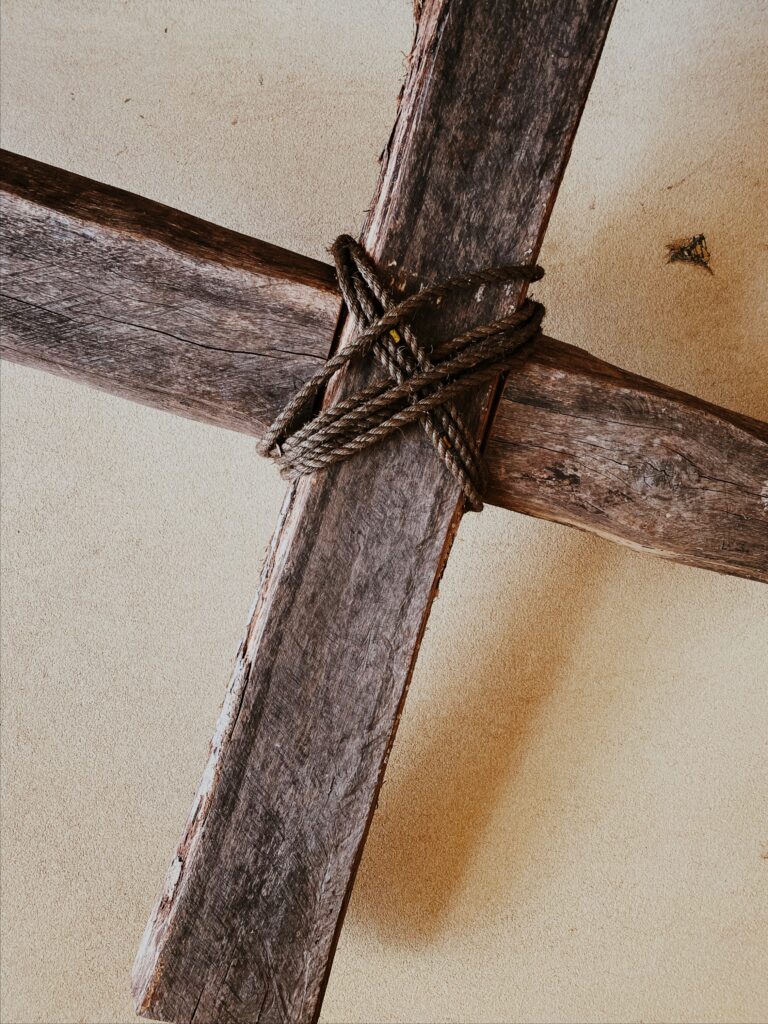

Seeing Easter through fresh eyes
“And I pray that you, being rooted and established in love, may have power, together with all the Lord’s holy people, to grasp how wide and long and high and deep is the love of Christ, and to know this love that surpasses knowledge—that you may be filled to the measure of all the fullness of God.” (Ephesians3:17b-19)
Last Sunday, we held an Easter outreach event for children here in Sakata. Thirteen children came along, with seven parents—most of whom are not Christians. I gave a short message, as well as helping organise some games. This coming Sunday, we are planning a “Welcome Service” for Easter, and I have been asked to share a short testimony about Easter in a way that any visitors will be able to understand. As I have been preparing both of these, I have been struck by the challenge of explaining the message of the cross and resurrection to people here whose worldview is very different and who have no church background and little, if any, knowledge of Jesus.
In Japan, Easter is still largely unknown. It is not marked in the calendar, there are no public holidays, and there is little sign of it in the shops. I did come across one display—plastic eggs, bunny ornaments, even duck-shaped marshmallows—but by last week even those had disappeared. Yet it is not only the customs that are unfamiliar. The central concepts—sin and grace, the crucifixion and resurrection—are also largely unknown in Japan. So where do you begin?
Since Christianity is viewed as a foreign religion, I find it helpful to look for examples from Japanese history or culture that might help provide a point of connection. One such example is Jo Niijima. In 1864, at a time when it was illegal to leave Japan, he secretly travelled to the United States. There he became a Christian, returning to Japan in 1874, shortly after the 259-year ban on Christianity had been lifted. Despite significant opposition, he founded the Doshisha English Academy the following year. He based the school on Christian principles but was forbidden to teach the Bible there. Instead, he taught it in his home initially.
In 1880, a dispute arose between some students and the school, and some of the students went on strike—an act of disobedience that called for discipline. At a morning worship, Principal Niijima announced to the students that their absence had been a violation of school regulations but insisted that the blame did not lie with them. Rather, as principal, he was the one to be blamed. “Therefore,” he said, “I must punish the principal.” He then took his cane and struck his own left hand so hard that the cane broke in two. The students were shocked as they watched the principal take the punishment that should have been theirs.
I find this story quite moving as I picture what happened in the school that morning. I felt something similar when I first encountered the scene in C.S. Lewis’s The Lion, the Witch and the Wardrobe, where Aslan is killed on the stone table in place of Edmund while his sisters watch in horror from a distance. There is something very poignant about stories like these – when an innocent person takes a punishment for someone else.
When Japanese people come to understand what Jesus did for them on the cross, it is often with a real sense of wonder that Jesus would love them enough to die for them. It is so new for them, and so much greater than any human or fictional comparison. At baptisms, they often give their testimony through tears.
I wonder, are we still moved in the same way by the story of Jesus dying for us on the cross, by how amazing it is that Jesus would take our punishment? Or is it possible that familiarity with the story can sometimes rob us of our wonder? Paul Tripp wrote the following about the dangers of becoming too familiar with a story in Come, Let Us Adore Him. It’s a daily advent devotional, but I think it is just as applicable to the Easter story:
“But familiarity often does bad things to us. Often when we become familiar with things, we begin to take them for granted… When we are familiar with things, we tend not to celebrate them as we once did. Familiarity tends to rob us of our wonder.”
Although challenging, it is a huge privilege to have the opportunity to share the Easter message with people who may never had heard “how wide and long and high and deep” Christ’s love is, or that Jesus died in their place. As I try to see the story through their eyes, I find myself freshly struck by its wonder. Perhaps that is something we all need—to see afresh what we know so well. As we approach Easter and take time to remember all that Jesus did for us on the cross, may each one of us have a fresh sense of wonder and gratitude.
By Lorna Ferguson
Latest posts

Seeing Easter through fresh eyes
I wonder, are we still moved in the same way by the story of Jesus dying for us on the…
You are seen
She gave this name to the Lord who spoke to her: “You are the God who sees me,” for she said, “I…
Finding a Way in the Will of God
“I make mention of you always in my prayers, making request if, by some means, now at last I may find…